
Overview
MSK First Contact Practitioners are regulated, advanced and autonomous healthcare professionals trained to provide expert MSK assessment, diagnosis and first-line treatment, self-care advice and if required and appropriate, discharge a person without medical or onward referral.
The development of First Contact Practitioner MSK (FCP) services across the UK allows people with musculoskeletal (MSK) conditions to access MSK physiotherapy expertise at the start of the pathway, ensuring timely access to diagnosis, early management and onward referral if necessary. This benefits patients, primary care and the wider MSK system.
Scope of Practice
Role Responsibilities
- Advanced MSK assessment and diagnosis
- Provide information on self-care and enable and support behaviour change
- Discuss fitness for work
- Undertake social prescribing
- Discuss physical activity and health (e.g. smoking cessation and weight management)
- Refer to a course of treatment (e.g. physiotherapy or podiatry)
- Refer to orthopaedic / rheumatology / pain services
- Request investigations
- Medicines optimisation
- Administer joint / soft tissue injections (if qualified).
Link for more information on MSK First Contact Practitioner: NHS England: MSK First Contact Practitioner
Entry Requirements
- BSc in Physiotherapy
- At least 3 years post graduate experience in MSK and 5 years post graduate study
- Health and Care Professions Council (HPCP) Registered
- Usually working at an Agenda for Change Band 7
- Advanced MSK practitioners (AP’s) may work at a Band 8a (the role is evaluated and will be determined by the complexity of the clinical workload and the scope of the role)
Training and Development
Standard Training (on entry to Primary Care)
First Contact Practitioner (FCP) Recognition
Musculoskeletal (MSK) Physiotherapists working as First Contact Practitioners (FCPs) are expected to work towards and maintain the knowledge, skills and capabilities outlined within the NHS England FCP Musculoskeletal Roadmap.
The roadmap provides a nationally recognised development pathway for clinicians working in primary care and supports progression towards advanced level practice.
The FCP Roadmap
The NHS England MSK FCP Roadmap sets out the knowledge, skills and attributes required to safely assess and manage undifferentiated and undiagnosed presentations within primary care. The roadmap consists of two stages:
Stage 1
- Demonstration of the required knowledge, skills and attributes (KSAs) at Level 7.
- This may be achieved through recognised taught learning, supported portfolio routes or a combination of both.
Stage 2
- Application of these capabilities within primary care practice.
- Supported through workplace supervision, portfolio development and workplace-based assessment.
- Includes reflective practice, patient feedback and evidence of capability within the clinical role.
Successful completion of both stages provides recognised FCP capability and demonstrates that the practitioner is working at the required standard for First Contact Practice in primary care.
Education providers
A number of higher education institutions offer programmes and modules aligned to the FCP Paramedic Roadmap. The availability, content and funding arrangements for these programmes may change over time, therefore prospective learners are advised to contact providers directly for the latest information.
Current NHS England funded providers include:
- Health Sciences University (formally known as AECC)
- University of Bradford
- University of Central Lancashire (UCLan)
- Coventry University
- University of Essex
- University of Hertfordshire
The above HEIs have also been formally recognised as delivering education and training in line with the relevant Roadmaps to Practice through the Provider Self-Declaration process. However, NHS England does not have funded places with these providers available.
- University of Plymouth – MSK
- University of Winchester – MSK
- St George’s University, London – MSK
- University of Salford – MSK
- Manchester Metropolitan University – MSK
- Sheffield Hallam University – MSK
- Liverpool Hope University – MSK
- University of Nottingham – MSK
- York St John University – MSK
Additional Training and Career Development
As physiotherapists progress in their careers, they may choose to undertake additional education and training to further develop their scope of practice within primary care. This may include development through First Contact Practitioner (FCP), Advanced Practice and other specialist pathways.
Advanced Practice
For physiotherapists wishing to progress beyond First Contact Practitioner level, NHS England provides a recognised route to Advanced Practice. Advanced Practitioners work with a high degree of autonomy and demonstrate capability across the four pillars of advanced practice: clinical practice, leadership and management, education, and research. For information on Advanced Practice pathways, education requirements, supervision and available funding opportunities, please visit the Training Hubs Advanced Practice page
Supervision Requirements
Effective supervision is essential to support safe practice, professional development and high-quality patient care. Physiotherapists working within primary care should have access to appropriate supervision arrangements that support both their clinical practice and ongoing learning.
Supervision may take a number of forms:
- Practice supervision – day-to-day support from an experienced clinician for issues arising during clinical practice.
- Clinical or professional supervision – regular structured support to promote professional development, clinical decision-making and reflective practice.
- Educational supervision – support for learners undertaking formal education programmes, FCP Roadmap development or Advanced Practice training.
Physiotherapists should have access to a named supervisor and appropriate support within their practice, PCN or organisation. This may be a senior physiotherapist, GP or another suitably experienced healthcare professional, depending on the individual’s role, learning needs and scope of practice.
As a minimum, regular supervision should be scheduled throughout employment. For those undertaking the First Contact Practitioner (FCP) Roadmap or Advanced Practice training, additional supervision, reflection and workplace-based learning opportunities should be incorporated into their development plan.
First Contact Practitioner (FCP) Supervision
Practitioners undertaking the NHS England Paramedic FCP Roadmap require appropriate workplace supervision to support the development and assessment of the knowledge, skills and attributes required for FCP practice.
Practice-based supervisors play an important role in supporting learners through the roadmap process, including:
- Supporting portfolio development.
- Facilitating workplace-based learning and assessment.
- Providing feedback and reflective opportunities.
- Confirming evidence of capability within clinical practice.
- Working with education providers as part of quality assurance and verification processes where applicable.
Further information can be found in the following NHS England resources:
- NHS England Supervision Guidance for Primary Care Network Multidisciplinary Teams
- NHS England First Contact Practitioner Roadmaps
- NHS England FCP Musculoskeletal Roadmap
Please note that NHS England continues to update FCP and Advanced Practice guidance. Employers, supervisors and practitioners should refer to the latest national guidance when establishing supervision arrangements.
ARRS Funding
Where eligible, reimbursement for Physiotherapist roles is available through the Additional Roles Reimbursement Scheme (ARRS) in line with current NHS England guidance and the Network Contract Directed Enhanced Service (DES).
Please note that ARRS eligibility criteria, reimbursement arrangements and role requirements may change. Employers should always refer to the latest NHS England guidance.
Training and Development Funding
Physiotherapists may be eligible for NHS England funded education and training opportunities, including First Contact Practitioner and Advanced Practice development. Availability of funding varies and is subject to national and regional commissioning arrangements.
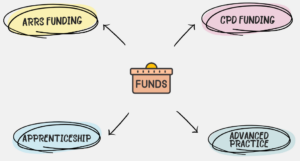
For current funding opportunities, please contact the Training Hub.
FCP Physiotherapists may be entitled to wider NHSE commissioned funding to support their training and development requirements. Please contact the training hub for more information on this.
Recruitment and Workforce Information
Primary Care Networks (PCNs) employing or engaging a Physiotherapists through the Additional Roles Reimbursement Scheme (ARRS) should ensure the individual meets the current NHS England eligibility and role requirements for the role. NHS England » Network Contract Directed Enhanced Service (DES). See more information in above ‘Funding section’.
Recruitment and Workforce Resources
The resources within this section are intended to support the recruitment, onboarding and integration of Physiotherapists within primary care and multidisciplinary teams.
What FCP Physiotherapists can offer you
About FCP Physiotherapy Services The Chartered Society of Physiotherapy (csp.org.uk)
Job description example (NHSE)
HEE Musculoskeletal First Contact Practitioner Services: Implementation guide
FCP Induction checklist example
GP Reception Materials and care navigator resources (Posters, screen savers, checklists)
Additional Resources
Professional Resources
MSK First Contact Practitioners Videos
Physiotherapist Peer Support Group Network
A local support network for Physiotherapists working in general practice.
To join this network please complete this form